Artikel: ingredient focus: Canadian colloidal clay

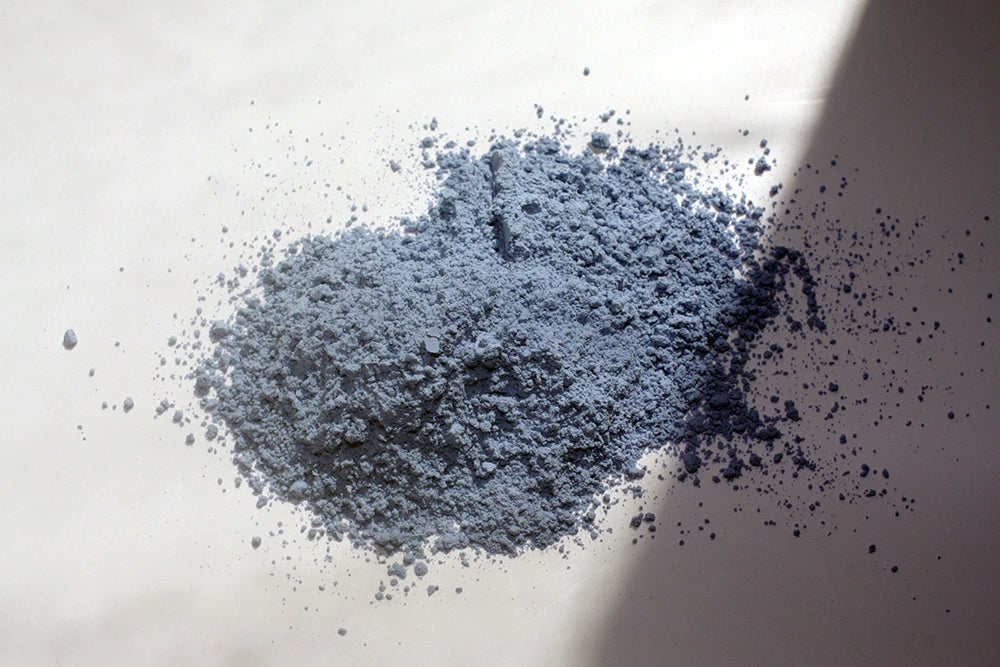
ingredient focus: Canadian colloidal clay

the bottom line
After a prolonged hiatus, we’re pleased to reintroduce our blue clay clarifying masque. while our first version contained rare Cambrian blue clay, our newest iteration features colloidal clay from Northwest Canada. An equally striking and unusual blue clay, it’s ideal for oily and congested skin. Keep reading to learn more about this blue beauty.
first layer: history
Canadian colloidal clay can be traced to the last glacial period which occurred 10,000 years ago. As the massive sheets receded, the surrounding bedrock was eroded, carrying rock fragments and minerals across the landscape. These mineral-rich sediments were transported to the Great Slave Lake region and settled over time to form thick layers of clay with fine mineral deposits.
Gold was discovered on the North Arm of the Great Slave Lake in the 1930’s, leading to the establishment of the city of Yellowknife, the eventual capital of the Northwest Territories of Canada. Located approximately 250 miles/400 km south of the Arctic Circle, Yellowknife was initially occupied by gold prospectors. The area surrounding this community however is the historic home of the Yellow Knives Dene, the land’s First Nations residents. Canadian colloidal clay is sourced from its Northwest Territories. As a byproduct of gold mining operations, this clay is exposed from ancient geological deposits and carefully harvested.
second layer: science
Clay is a natural, fine grain material formed from rock or soil. It’s made up of mineral constituents which consist of clay minerals including illite, kaolinite, montmorillonite-smectite, and chlorite, as well as other associated minerals. Clay minerals form over long periods of time as rock weathers, or through hydrothermal activity. They have historically been used as medical remedies for the treatment of wounds as aids in the reduction of inflammation. Clays which contain iron, copper, and zinc are of special interest for wound healing, as these minerals are essential ingredients in collagen* formation.
Clays have also been extensively studied for antibacterial use, particularly against antibiotic-resistant bacterial strains. By identifying both the natural environment of clays which are toxic to bacteria, as well as how these clays actually destroy microbes, new potential antibiotics can be developed. Natural antibacterial clays contain nanoscale (less than 200 nm), illite-smectite, and reduced iron phases.
The mineral and chemical compositions of clays vary according to their geologic environments, and therefore it is difficult to extrapolate data from one clay to another. However, blue clay obtains its hue from reduced iron, and therefore studies relating to this mineral can still be instructive. Blue clay sourced from the Cascade Mountains in Oregon has been studied for its antibacterial use. In one study, it demonstrated elimination of Escherichia coli, Staphylococcus aureus, Pseudomonas aeruginosa, Salmonella typhimurium, as well as antibiotic-resistant strains, within 24 hours of contact. Within the leachate* of this clay, significantly high levels of aluminium, phosphorus, iron, and copper have been identified. It is believed that the hydration of the clay results in dissolution of the iron and aluminum from the minerals, which then act synergistically to damage bacterial cell membranes. Clays which buffer water to neutral pH values are not antibacterial. In the studies on Oregon blue clay, the suspensions maintained a low pH.
Canadian colloidal clay is a multi-mineral hybrid blue clay. It is composed primarily of silicon, aluminum, iron, calcium, sodium, magnesium, and potassium.
third layer: skin care
Clays fall into two general categories: absorbent (absorbs water and swells), and adsorbent (attract particles but don’t swell). Absorbent clays adhere to the skin, and are able to absorb excess sebum, bacteria, dead skin cells, and blackheads. Adsorbent clays, on the other hand, attract dirt and grime to the clay particle, and do not swell with the addition of water. Adsorbent clays are ideal for dry and sensitive skin, while absorbent clays are preferable for oily skin types.
We consider Canadian colloidal clay to be an absorbent clay, and therefore recommend it for oily skin types. To use this clay as a masque, add approximately 1 teaspoon of dry powder to a small, clean bowl (avoid metal instruments and dishes to avoid any reaction with the clay). Add enough water or other liquid of your choice and mix until the clay has a smooth and creamy consistency. Apply to the face with fingers or a brush to evenly coat the skin. Allow to dry partially then remove gently with lukewarm water. Follow with your usual toner, serum, and moisturizer.
fourth layer: how we do it
We’ve reformulated our blue clay clarifying masque solely with rare Canadian colloidal clay to gently draw out impurities, absorb excess sebum, and refine the look of pores without stripping the skin's delicate moisture barrier. Rich in minerals, it leaves the complexion feeling deeply refreshed, soft, and balanced.
All this and more at www.anokhaskincare.com .
xx
anokha
references:
-
https://ec.europa.eu/growth/tools-databases/cosing/details/55227
-
Morrison KD, Misra R, Williams LB. Unearthing the Antibacterial Mechanism of Medicinal Clay: A Geochemical Approach to Combating Antibiotic Resistance. Sci Rep. 2016 Jan 8;6:19043. doi: 10.1038/srep19043. PMID: 26743034; PMCID: PMC4705759.
-
Williams LB, Metge DW, Eberl DD, Harvey RW, Turner AG, Prapaipong P, Poret-Peterson AT. What makes a natural clay antibacterial? Environ Sci Technol. 2011 Apr 15;45(8):3768-73. doi: 10.1021/es1040688. Epub 2011 Mar 17. PMID: 21413758; PMCID: PMC3126108.
-
Carretaro MI. Clay minerals and their beneficial effects upon human health. A review. Appl Clay Sci 2002; 21: 155-163.
-
Caflisch KM, Schmidt-Malan SM, Mandrekar JN, Karau MJ, Nicklas JP, Williams LB, Patel R. Antibacterial activity of reduced iron clay against pathogenic bacteria associated with wound infections. Int J Antimicrob Agents. 2018 Nov;52(5):692-696. doi: 10.1016/j.ijantimicag.2018.07.018. Epub 2018 Jul 31. PMID: 30075292.
-
Williams LB, Haydel SE. Evaluation of the medicinal use of clay minerals as antibacterial agents. Int Geol Rev. 2010 Jul 1;52(7/8):745-770. doi: 10.1080/00206811003679737. PMID: 20640226; PMCID: PMC2904249.
-
Cunningham TM, Koehl JL, Summers JS, Haydel SE. pH-Dependent metal ion toxicity influences the antibacterial activity of two natural mineral mixtures. PLoS One. 2010 Mar 1;5(3):e9456. doi: 10.1371/journal.pone.0009456. PMID: 20209160; PMCID: PMC2830476.
faq’s:
what is clay?
clay is a natural, fine grain material formed from rock or soil. it’s made up of mineral constituents which consist of clay minerals such as illite, kaolinite, montmorillonite-smectite, and chlorite, as well as associated minerals such as magnetite, hematite, and diaspore.
*definitions:
collagen: a fibrous protein that forms part of the dermal matrix, connective tissue, cartilage, and bone
leachate: any liquid that passes through matter and extracts soluble or suspended solids
*the Food and Drug Administration (FDA) has not evaluated the statements on this website. no claims are made as to the medicinal value of any products from anokha®. the information presented here is for educating our customers and is not intended to diagnose, treat, cure, or prevent any disease. if you have any questions, please email us for further information: hello@anokhaskincare.com
Mehr erfahren
Bakuchiol ist einer der aufregendsten natürlichen Wirkstoffe, die auf den Markt kommen. Bakuchiol wurde von Mintel als einer der trendigsten Inhaltsstoffe des Jahres 2019 gefeiert und erschien all...
Weiterlesen
Hinterlasse einen Kommentar
Diese Website ist durch hCaptcha geschützt und es gelten die allgemeinen Geschäftsbedingungen und Datenschutzbestimmungen von hCaptcha.